At ʿAyn Jalut: Breaking the Myth of the Invincible Army
The most dangerous thing about a rising power is not its weapons but the myth that runs ahead of it. The first push begins when someone refuses to believe the myth.
Editorial board
The envoys’ heads on Bab Zuwayla
In February 1258 Hulagu, grandson of Genghis Khan, entered Baghdad after a short siege, sacked it and killed the Abbasid caliph al-Mustaʿsim, ending the Abbasid caliphate that had lasted five centuries. His army then advanced into Syria, and Aleppo fell, then Damascus.
Hulagu sent envoys to Cairo, to the Mamluk sultan Sayf al-Din Qutuz, with a letter demanding surrender and threatening ruin. The cities of the East were falling to the Mongols one after another, and many believed resistance was suicide.
But Qutuz had the envoys killed and hung their heads on Bab Zuwayla, a gate of Cairo. It was a declaration from which there was no going back.
Then news arrived that changed the calculation: Hulagu had withdrawn eastward with most of his army, leaving a smaller force in Syria under his general Kitbuqa. Qutuz marched out of Egypt with his army, and with him the commander Baybars.
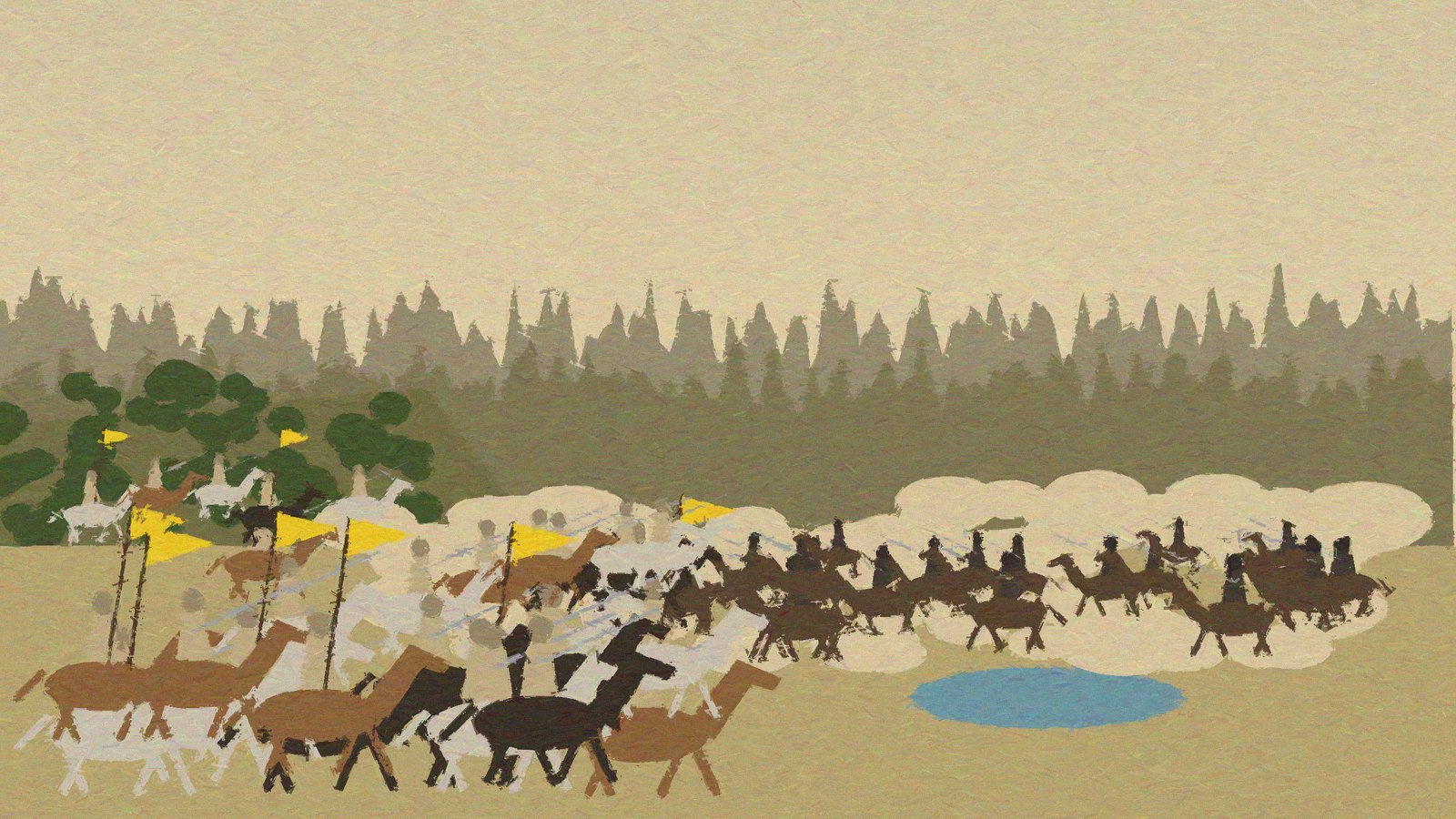
On 3 September 1260, the 25th of Ramadan in the year 658 of the Hijra, the two armies met at a spring in the plain of Marj Ibn ʿAmir in Palestine called ʿAyn Jalut, the Spring of Goliath. Baybars advanced with the vanguard, then feigned a retreat; the Mongols pursued him until they were caught among the hills in the Mamluk army’s ambush. Kitbuqa was killed, and the Mongol army broke.
It was the first time the Mongol advance westward was halted for good. They never again occupied Syria.
Source: al-Maqrizi, “al-Suluk li-maʿrifat duwal al-muluk”; Reuven Amitai-Preiss, “Mongols and Mamluks” (1995).
It is a striking coincidence that the battle that stopped the Mongols took place at a spring bearing the name of Goliath, Jalut, the very name that appears in the verse on which our whole project rests. We do not claim that the place is the site of the ancient battle between David and Goliath; historians disagree about that, and the name is a traditional one. But the coincidence opens a door to reflection.
﴿فَهَزَمُوهُمْ بِإِذْنِ اللَّهِ وَقَتَلَ دَاوُودُ جَالُوتَ وَآتَاهُ اللَّهُ الْمُلْكَ وَالْحِكْمَةَ وَعَلَّمَهُ مِمَّا يَشَاءُ ۗ وَلَوْلَا دَفْعُ اللَّهِ النَّاسَ بَعْضَهُمْ بِبَعْضٍ لَفَسَدَتِ الْأَرْضُ﴾[البقرة: 251]
“So they defeated them by God’s leave, and David killed Goliath, and God gave him kingship and wisdom and taught him of what He willed. And were it not for God repelling some people by means of others, the earth would have been corrupted.” (Al-Baqarah 2:251)
The myth is a weapon too
Before ʿAyn Jalut the Mongols had built a reputation that made cities surrender before they were besieged. That reputation was a real weapon that saved them battles. The rule in military pushing back is that a rising power wins many of its battles through the fear it sows, not by the sword alone. That is why the most important thing Qutuz did before the battle was his decision to refuse surrender. He did not defeat the Mongols only on the day of ʿAyn Jalut; before that he defeated the idea that they could not be defeated.
A careful reading of the causes
The heroic narrative alone is not enough, however, and our method is to give all the causes. Hulagu’s withdrawal with most of his army was decisive. It used to be explained by the death of the Great Khan Möngke, but Hulagu himself, in a later letter, attributed his withdrawal to the difficulty of supplying a huge army in Syria and the scarcity of pasture there. Nor was the Mamluk army a “small band” facing a vast host; most historians think the two armies were roughly equal, and the Mamluks may have outnumbered them. And the Mamluks were a professional army trained from childhood in mounted combat and archery, the same military type in which the Mongols excelled.
This reading does not diminish the victory; it makes it more useful. The lesson is not that faith alone defeats armies, but that steadfastness joined to preparation and the choice of moment and ground makes the difference. That is what the verse says: “they defeated them by God’s leave”; the divine leave comes within a human action complete in its causes.
Contention does not stop at victory
The story has an ending rarely told. Weeks after the victory, on the way back to Egypt, Qutuz was killed by emirs among his companions, Baybars among them, and Baybars became sultan. Contention did not stop when the external enemy was defeated; it moved at once to the inside. This recalls a rule we set out in the first issue: victory is no proof of right, and fortunes rotate, even among the victors.
In sum
ʿAyn Jalut was neither a miracle cut off from causes nor a military victory empty of meaning. It was a push in which will, preparation and opportunity came together and stopped a force that seemed unstoppable. Without that push, the history of Egypt and Syria, and perhaps of the whole Muslim world, would have been other than the one we know.