Greta Thunberg: The Student Who Sat Alone
At fifteen she sat alone on the pavement outside the Swedish parliament with a sign she had written by hand. A year later millions of young people marched in cities around the world.
Editorial board
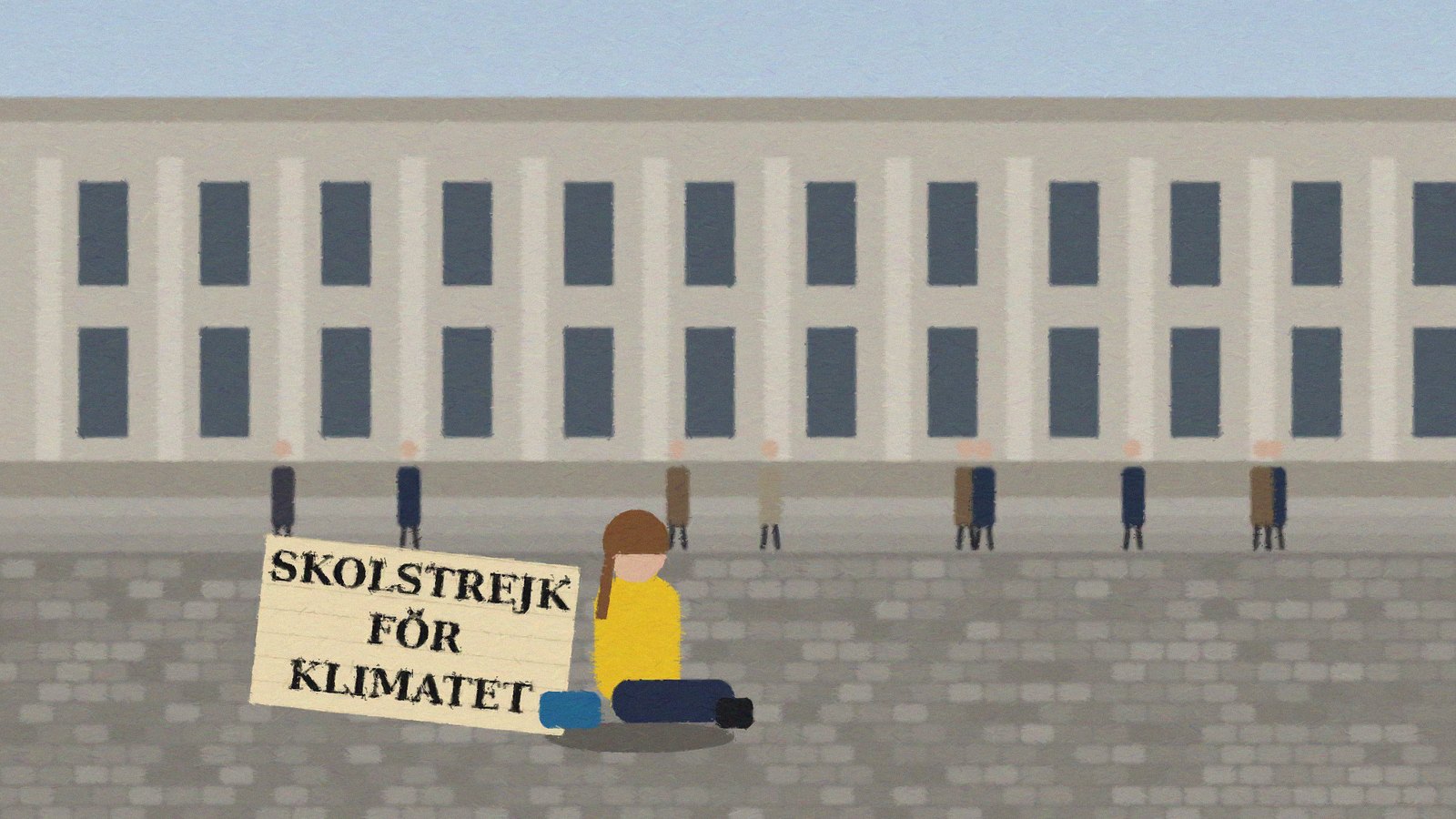
A wooden sign
On the morning of 20 August 2018 a fifteen-year-old Swedish student was supposed to start the school year. She did not go to school. She carried a wooden board on which she had written by hand “School strike for climate”, and sat with it on the pavement outside the parliament building in Stockholm.
She had tried to persuade classmates to join her, and no one was interested. So she sat alone. She handed out leaflets to passers-by explaining that she would not go to school until the parliamentary elections three weeks later, because adults were not taking the climate crisis seriously.
Before that she had spent about two years persuading her own family to change their way of life: to stop flying and to consume less. Her mother, an opera singer, gave up international engagements.
After the elections she kept sitting there every Friday. By December of that year more than twenty thousand students were striking in more than two hundred and seventy cities. On 20 and 27 September 2019 millions marched in cities around the world; one of the organisers estimated their number at more than four million.
A month earlier she had crossed the Atlantic on a sailing yacht in fifteen days, refusing to fly, to stand at the United Nations climate summit in New York and tell the world’s leaders: “How dare you? You have stolen my dreams and my childhood with your empty words.”
Source: Greta Thunberg’s speech at the UN Climate Action Summit, 23 September 2019; the Fridays for Future movement; Time magazine, Person of the Year 2019.
We close this issue with the youngest of those who pushed back and the closest to our own time; indeed, she is still in the middle of her story. Her story brings together elements we have seen in the earlier lives: beginning alone, as Ibn al-Nafis did in his critique of Galen; the strike as an instrument, as in Montgomery; and the direct word to those in power, as with al-ʿIzz ibn ʿAbd al-Salam.
﴿ظَهَرَ الْفَسَادُ فِي الْبَرِّ وَالْبَحْرِ بِمَا كَسَبَتْ أَيْدِي النَّاسِ لِيُذِيقَهُمْ بَعْضَ الَّذِي عَمِلُوا لَعَلَّهُمْ يَرْجِعُونَ﴾[الروم: 41]
“Corruption has appeared on land and sea because of what people’s hands have earned, so that He may let them taste part of what they have done, that perhaps they will return.” (Al-Rum 30:41)
The Quran attributes corruption on land and sea to what people’s hands have earned. We do not need to tie the verse to the climate crisis specifically to draw a general rule from it: what people do on the earth comes back to them, and the purpose of letting them taste some of its consequences is that they return. Contention over climate is contention over this return: who pushes toward it, who pushes against it, and who postpones it.
Beginning alone
The first striking thing in Greta’s story is that she began alone. She was not a member of an organisation, and had no funding or party behind her. This corrects a common idea about pushing back: that it needs a group before it can begin. The group often comes after someone has begun, not before. The individual who bears the cost of beginning alone gives others proof that action is possible, and so lowers their cost of joining. We saw in the Montgomery article in the second issue that lowering the cost to the individual is the key to collective action.
Example before speech
The second point is that she applied what she called for to herself and her family before demanding it of the world. She refused to fly even for her trip to New York, crossing the ocean by sailing yacht in both directions. This consistency between word and deed was the source of her moral force, because it removed an accusation every advocate of change faces: that they ask of others what they do not do themselves.
She has said that her diagnosis of Asperger’s syndrome, which she has spoken about publicly, helped her see things “in black and white”, and she called it a “superpower”. That sharpness of vision is the very thing that made her speech powerful for many and off-putting for others.
“Listen to the scientists”
One of the shrewdest things she did was not to present herself as a scientific authority. She repeated that politicians should not listen to her, but to the scientists. She did not make herself a party to the scientific debate; she aimed her push at the gap between what scientists say and what governments do. This recalls Ida B. Wells, who built her argument on her opponents’ numbers: the strongest push rests on an authority the other side recognises.
The limits of the life
Greta is one of the most divisive figures of our time, and we must present what is said about her fairly. Her critics argue that her rhetoric simplifies complex questions, that its tone of anger and alarm polarises people instead of persuading them, and that demanding very rapid emission cuts ignores the cost to the poor and to developing countries. Major political leaders have mocked her publicly.
In recent years she has also widened the range of her causes, taking part in protests that led to her arrest and fines in more than one country, and in 2025 she joined two flotillas that tried to break the blockade of Gaza; Israeli forces intercepted them and she was deported. This won her wide support in the Arab and Muslim world, but cost her some support in the West, to the point that her movement’s German branch declared that her positions on Gaza did not represent it. People differ over this, some seeing moral consistency in someone who pushes back against injustice wherever it is, and others seeing a departure from the cause around which her public gathered.
We do not judge these disputes; we record them. Her life is not yet complete, and judging the living is harder than judging those who have passed. But what is established is that a fifteen-year-old student sat alone on a pavement, and changed the way the world talks about an issue that touches the future of the whole earth.
Closing the issue
Ten lives, from Saladin in the twelfth century to Greta Thunberg in the twenty-first. Their religions, races and instruments differed: sword, pulpit, scalpel, pen, laboratory, ring and sign. But they share this: they did not accept what others had accepted, and they paid for it with years of their lives and their freedom. All of them had faults, which we have recorded, because the law does not need saints; it needs human beings who decide to push back.