Ibn al-Nafis: When a Physician Said “No” to Galen
Galen’s view of the heart was taken for granted for more than a thousand years. Then a physician from Damascus said that dissection did not support it. And his words were forgotten for six centuries.
Editorial board
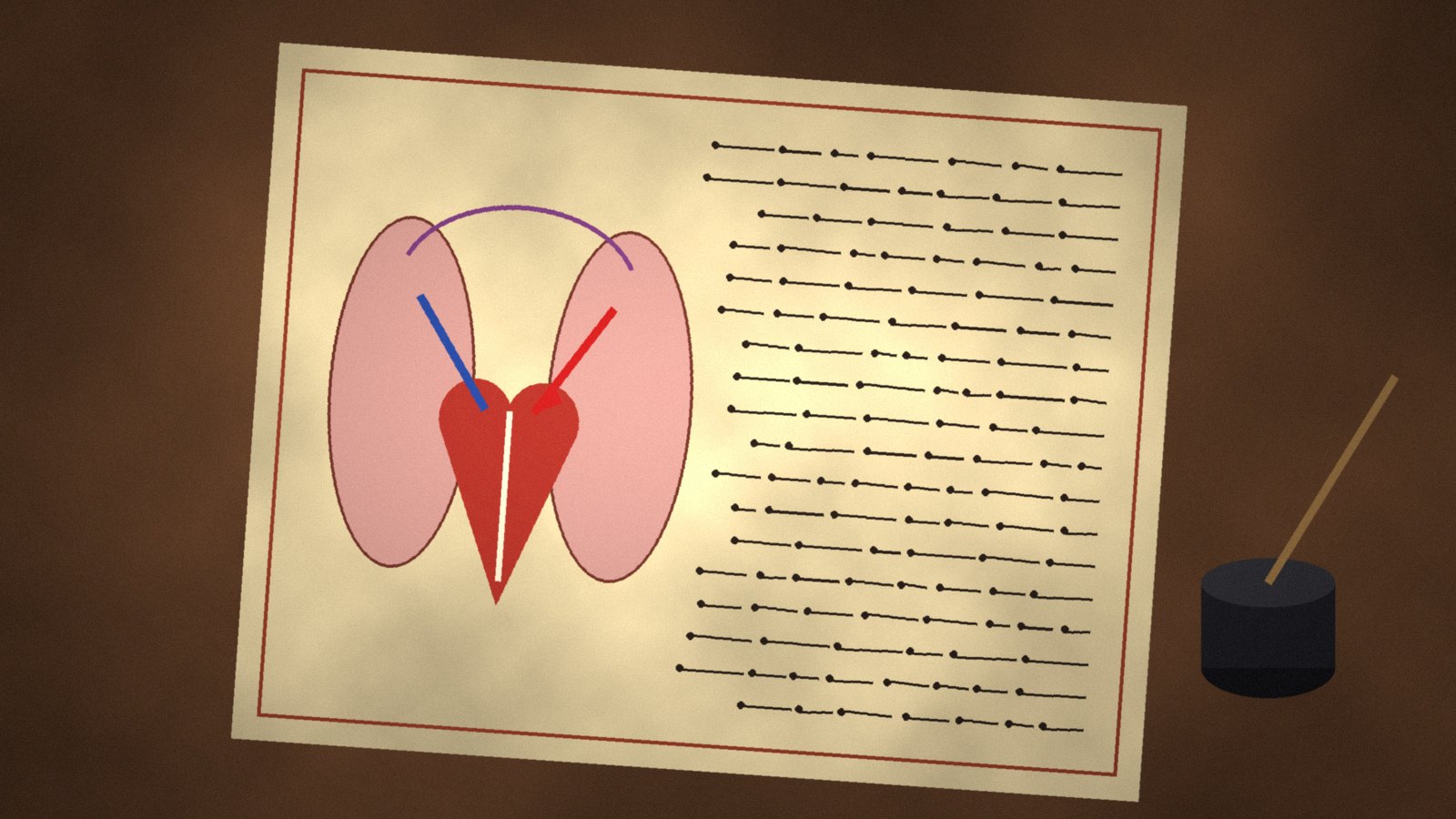
A wall without holes
Medicine in the thirteenth century rested on a great heritage the Muslims had inherited from the Greeks, headed by the Greek physician Galen, who lived in the second century CE. Galen had held that blood passes from the right ventricle of the heart to the left through invisible pores in the wall between them. Avicenna followed him in his Canon, and the view became an axiom that was hardly questioned.
In Cairo a Damascus-born physician named ʿAlaʾ al-Din ibn al-Nafis was writing a commentary on the anatomy section of Avicenna’s book. When he reached this point, he wrote words no one had written before him: this wall is solid; it has no visible passage, as some supposed, nor an invisible one, as Galen supposed.
He went on to state that blood leaves the right ventricle for the lung, mixes with air there, and then returns to the left ventricle. This is the lesser, or pulmonary, circulation. He also wrote that the heart is not nourished by the blood in its cavities but by vessels in its own body, an early pointer to what we now call the coronary arteries.
Ibn al-Nafis died in Cairo in 1288, leaving his house and library to the Mansuri hospital. His book remained in manuscript. The modern world learned what it contained only in 1924, when a young Egyptian physician named Muhyi al-Din al-Tatawi found a copy in a Berlin library and wrote his dissertation on it.
Source: Ibn al-Nafis, “Sharh Tashrih al-Qanun”; Muhyi al-Din al-Tatawi’s dissertation (Freiburg, 1924); studies by Max Meyerhof.
Cardiologists know today that blood passes from the right ventricle into the pulmonary artery and the lungs, then returns through the pulmonary veins to the left atrium. A medical student learns this in the first year. But reaching it took a man with the courage to say that the greatest authority in his field had been wrong.
﴿فَأَمَّا الزَّبَدُ فَيَذْهَبُ جُفَاءً ۖ وَأَمَّا مَا يَنْفَعُ النَّاسَ فَيَمْكُثُ فِي الْأَرْضِ﴾[الرعد: 17]
“As for the foam, it goes away as scum; and as for what benefits people, it remains on the earth.” (Al-Raʿd 13:17)
Pushing back in science
Science is a field of contention of a special kind. Ideas push against each other in it, and authority is a force that shields old ideas from criticism. The greater the authority, the harder it is to push back. Galen was no ordinary authority; he was a proof-text for Muslims and Christians alike for nearly a thousand years. What Ibn al-Nafis did was not an addition to Galen’s science but the overturning of one of its pillars.
Strikingly, he did so in a book that is a “commentary” on Avicenna. He did not raise the banner of revolt against the tradition; he worked from inside it. This is a form of pushing back known in every civilisation: criticism that comes in the form of commentary, staying connected to the original while correcting it.
The push that was not heard
But the story of Ibn al-Nafis carries a sad lesson too. His discovery had no effect in his own age. No one built on it, it was not taught, and the practice of medicine in Cairo or Damascus did not change because of it. About three centuries later European scholars, such as the Spaniard Michael Servetus and the Italian Realdo Colombo, described the pulmonary circulation, and in 1628 the Englishman William Harvey published his description of the full circulation of the blood. Historians still disagree over whether Ibn al-Nafis’s ideas reached them by some route, or whether they arrived at them independently.
Here is a subtle face of the law of pushing back: a correct idea does not win by being correct alone. It needs an environment to carry it: educational institutions that adopt it, a scientific community that tests and builds on it, and printing that spreads it. When that environment was absent, Ibn al-Nafis’s idea stayed like water under the foam, until al-Tatawi brought it out six centuries later.
The limits of the life
We should beware of two exaggerations. The first is to make Ibn al-Nafis the discoverer of the whole circulation of the blood, which is not true: what he described was the pulmonary circulation, while the greater circulation was described by Harvey. The second is to take his priority in time as proof that others copied from him, which has not been established. The fair statement is that he was the first we know of to describe the pulmonary circulation correctly in writing, and that he did so with rare scientific courage.
It is a courage every generation needs. Every science has its “Galen”, an old view protected by a great name. Scientific pushing back begins when someone says, politely: I have looked for myself, and I did not see what you said.