Saladin: The Push That Did Not Turn Into Revenge
He recovered Jerusalem eighty-eight years after a massacre the Crusaders had committed there. He could have answered it in kind, and did not.
Editorial board
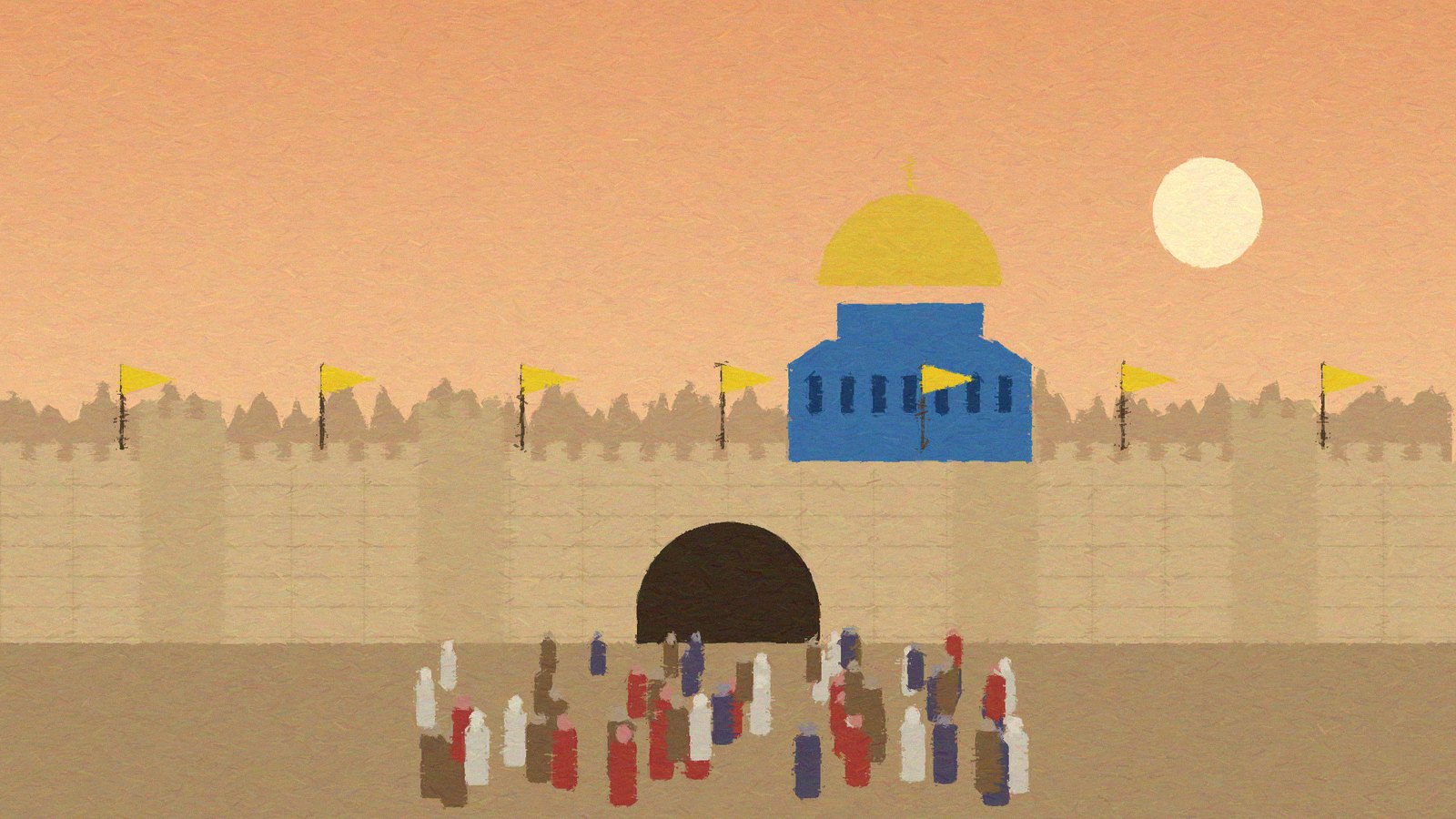
The city that was not sacked
In July 1099 the Crusaders stormed Jerusalem and committed a massacre that historians on both sides reported spared neither fighter nor civilian, until their own chroniclers wrote that in places the blood rose to the ankles.
Eighty-eight years later, in September 1187, Saladin stood before the walls of the same city, three months after crushing the Crusader army at Hattin. He had sworn to take it by force, as it had been taken.
The commander of the defenders, Balian of Ibelin, came out to negotiate. When he saw Saladin unyielding, he threatened to kill the Muslim prisoners in the city, destroy the Dome of the Rock and al-Aqsa Mosque, burn the city, and then lead the Crusaders out to fight to the death.
Saladin accepted surrender for a fixed ransom: ten dinars for a man, five for a woman and two for a child. On 2 October 1187, the 27th of Rajab in the year 583 of the Hijra, the Muslims entered Jerusalem without a massacre.
When thousands of the poor remained unable to pay, his brother al-ʿAdil freed a thousand of them, Saladin freed crowds of the elderly and the poor, and Crusader clergy paid for others. The Church of the Holy Sepulchre remained open to Christians.
Source: Bahaʾ al-Din ibn Shaddad, “al-Nawadir al-Sultaniyya”; ʿImad al-Din al-Isfahani, “al-Fath al-Qussi fi al-Fath al-Qudsi”.
Saladin is usually remembered as the liberator of Jerusalem. But what concerns us in his life, from the angle of pushing back, is two things: how he built the capacity to push back, and how he restrained the push when it reached its goal.
﴿وَلَوْلَا دَفْعُ اللَّهِ النَّاسَ بَعْضَهُمْ بِبَعْضٍ لَهُدِّمَتْ صَوَامِعُ وَبِيَعٌ وَصَلَوَاتٌ وَمَسَاجِدُ يُذْكَرُ فِيهَا اسْمُ اللَّهِ كَثِيرًا﴾[الحج: 40]
“And were it not for God repelling some people by means of others, monasteries, churches, synagogues and mosques in which God’s name is much remembered would have been demolished.” (Al-Hajj 22:40)
Building capacity before the battle
Hattin was not a stroke of luck. Saladin spent more than twelve years uniting Egypt, Syria and the Jazira under a single authority, and many of those years went into struggle with Muslim princes rather than with the Crusaders. This is a side rarely mentioned in heroic accounts: the external push first required settling the internal contention. Scattered principalities could not push back the Crusader kingdoms; unity was the condition of capacity.
A restrained push
When the moment of Jerusalem came, Saladin faced the temptation of revenge. Revenge would have been understandable; he had even sworn to it. But he chose surrender for ransom. His decision can be read in two ways. The first is moral: he refused to answer massacre with massacre. The second is practical: Balian’s threat to destroy the holy places made storming the city very costly. Most likely the two came together, and it does the life no harm that principle and calculation met in it.
The verse of Al-Hajj at the head of this article makes the protection of all houses of worship, monasteries, churches, synagogues and mosques, one of the purposes of pushing back. The Church of the Holy Sepulchre remained in Christian hands after the conquest, in keeping with the spirit of the verse.
The limits of the life
Honesty requires that we not paint a picture without shadows. The ransom was not free release. Those of Jerusalem’s inhabitants who could not pay it, whom the sources number in many thousands, were sold into slavery, despite those who were freed. At Hattin itself Saladin ordered the killing of the captured Templar and Hospitaller knights, and with his own hand killed Reynald of Châtillon, lord of Kerak, who had treacherously attacked caravans and the pilgrimage road. These were the customs of war in his time, but they are part of the picture.
Even so, what he did in Jerusalem was exceptional by the standards of his age, so much so that European historians wrote of him with admiration, and he became in Western literature the model of the noble knight. This is another face of pushing back: to defeat your adversary on the field, and then to defeat his image of you in memory.