The Register of the Arabs: When Poetry Was the Field of Pushing Back
Before Islam the Arabs had no state, no press and no standing army. They had poetry. Poetry was their media, their record and their weapon, and a field on which they pushed against each other as they did with swords.
Dr. Tarek Abou Ghazala, Editor-in-chief
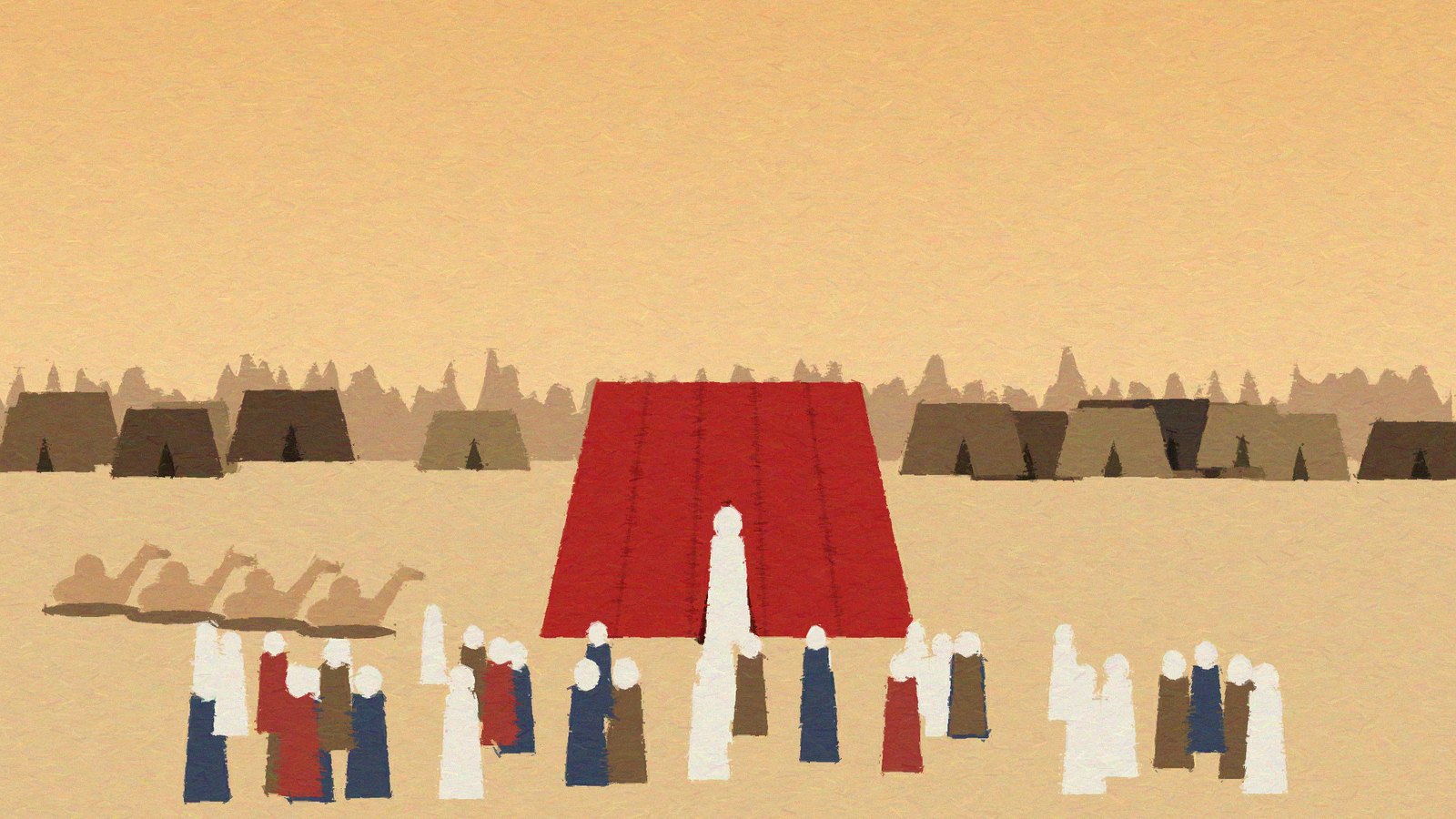
The red dome at ʿUkaz
The market of ʿUkaz, between Nakhla and Taʾif, gathered the Arabs every year in the month of Dhu al-Qaʿda. They traded, boasted and settled their disputes. And its most famous feature was poetry.
The books of literature relate that a red leather dome used to be pitched at ʿUkaz for al-Nabigha al-Dhubyani, where poets came to recite their verse to him and he judged between them. One year al-Aʿsha recited to him, then Hassan ibn Thabit, then al-Khansaʾ recited her elegy for her brother Sakhr. Al-Nabigha told al-Khansaʾ: had Abu Basir, meaning al-Aʿsha, not recited to me before you, I would have said you were the greatest poet of all.
Hassan was angered and said: by God, I am a better poet than you and your father. Al-Nabigha replied: my nephew, you could not compose the like of my line:
“You are like the night that overtakes me, though I think the place of escape from you is wide.”
Whether or not its details are true, this story sums up what poetry was for the Arabs: an open field of competition, with its judges, its audience and its customs, in which one name rose and another fell, and a tribe won or lost.
Source: Abu al-Faraj al-Isfahani, “Kitab al-Aghani”, reports on al-Nabigha al-Dhubyani. The report is one of the literary narratives whose details cannot be confirmed.
Ibn Rashiq al-Qayrawani wrote in “al-ʿUmda” that when a poet emerged in an Arab tribe, other tribes came to congratulate it, food was prepared, and the women gathered to play the lute as at weddings, because the poet was “a protection of their honour, a defence of their lineage, an immortalising of their deeds and a proclamation of their fame”. That phrase alone defines the function of poetry in tribal contention: defence, protection and proclamation. In a word, pushing back.
Why the Muʿallaqat?
The Muʿallaqat, the “hanging odes”, are long poems the transmitters selected from the finest pre-Islamic poetry. The best-known count is seven: by Imruʾ al-Qays, Tarafa ibn al-ʿAbd, Zuhayr ibn Abi Sulma, Labid ibn Rabiʿa, ʿAmr ibn Kulthum, ʿAntara ibn Shaddad and al-Harith ibn Hilliza. Some added al-Aʿsha, al-Nabigha and ʿAbid ibn al-Abras, making ten. We have followed the order of al-Zawzani in his commentary on the seven.
We chose them because, in texts close to one another in time, they offer seven patterns of pushing back: a prince who pursues revenge for his father until he seeks help from Caesar; a young man who satirises a king and carries the letter ordering his own death; a sage who praises those who put out a war that lasted decades; an aged man who sees all of nature pushing against itself; a chief who kills a king to avenge his mother’s dignity; a slave who pushes slavery off himself with his sword; and an old man who pleads his people’s case before a king in a blood dispute.
The three axes
Ibn Qutayba described the structure of the classical Arabic ode in the introduction to “al-Shiʿr wa al-Shuʿaraʾ”: the poet begins by mentioning the abodes, the dung-marks and the traces, weeping and lamenting; he links this to the love prelude; then he sets out on a journey, describing his camel or horse and what he met on the way; then he reaches his purpose of praise, boast or the like. Not every Muʿallaqa keeps strictly to this structure, but it serves as a way into reading them.
So we read each Muʿallaqa in this issue along three axes:
The first axis: standing at the ruins. In our reading this is the human being pushing against time. The ruins are traces that wind and rain erase, and the poet stops to recover what time erases. We will see that the poets themselves described this erasure in the language of pushing back: winds that alternate, torrents that uncover and cover.
The second axis: describing the mount, horse or camel. It is the poet’s instrument of pushing back: with it he crosses the desert, seeks revenge, escapes danger and reaches his goal. Poets often liken their mounts to wild animals waging their own struggle against hunter, wolf or thirst.
The third axis: describing the journey. It is the road on which the poet pushes against desert, night and fear, before reaching his real purpose, which in most of the Muʿallaqat is a contention with people: war or peace, boast or pleading.
A note on method
Honesty requires two remarks. The first is that the story of these poems being hung on the curtains of the Kaʿba, written in gold, is not established in the view of many scholars, classical and modern; most hold that the name came from their preciousness, as jewels are hung, or from how hearts clung to them. The second is that the authenticity of pre-Islamic poetry as a whole stirred wide debate in the twentieth century, when the orientalist Margoliouth and then Taha Husayn, in his book “On Pre-Islamic Poetry” (1926), cast doubt on the attribution of much of it; many scholars answered them, most famously Nasir al-Din al-Asad in “The Sources of Pre-Islamic Poetry”. The prevailing view today is that the bulk of this poetry is pre-Islamic in origin, though transmission introduced some additions and variants.
The same goes for the reports that tell the occasions of these poems: they are narratives collected by transmitters centuries later, some acceptable and some to be treated with reserve. We tell them as stories that reveal how the Arabs understood their poetry, not as conclusive historical documents.
The lines of the Muʿallaqat vary between the commentaries. We have used the best-known recension, and checked some lines against al-Zawzani’s commentary. The English renderings of the verses are our own and aim at meaning, not at poetry.
Issue contents: The Seven Muʿallaqat on the Scale of Pushing Back