Al-Harith ibn Hilliza: Pleading From Behind Seven Curtains
An ailing old man stands before a king who hates to see him, to plead his people’s case in a blood dispute. He recited from behind a curtain, and the curtains were raised one after another.
Editorial board
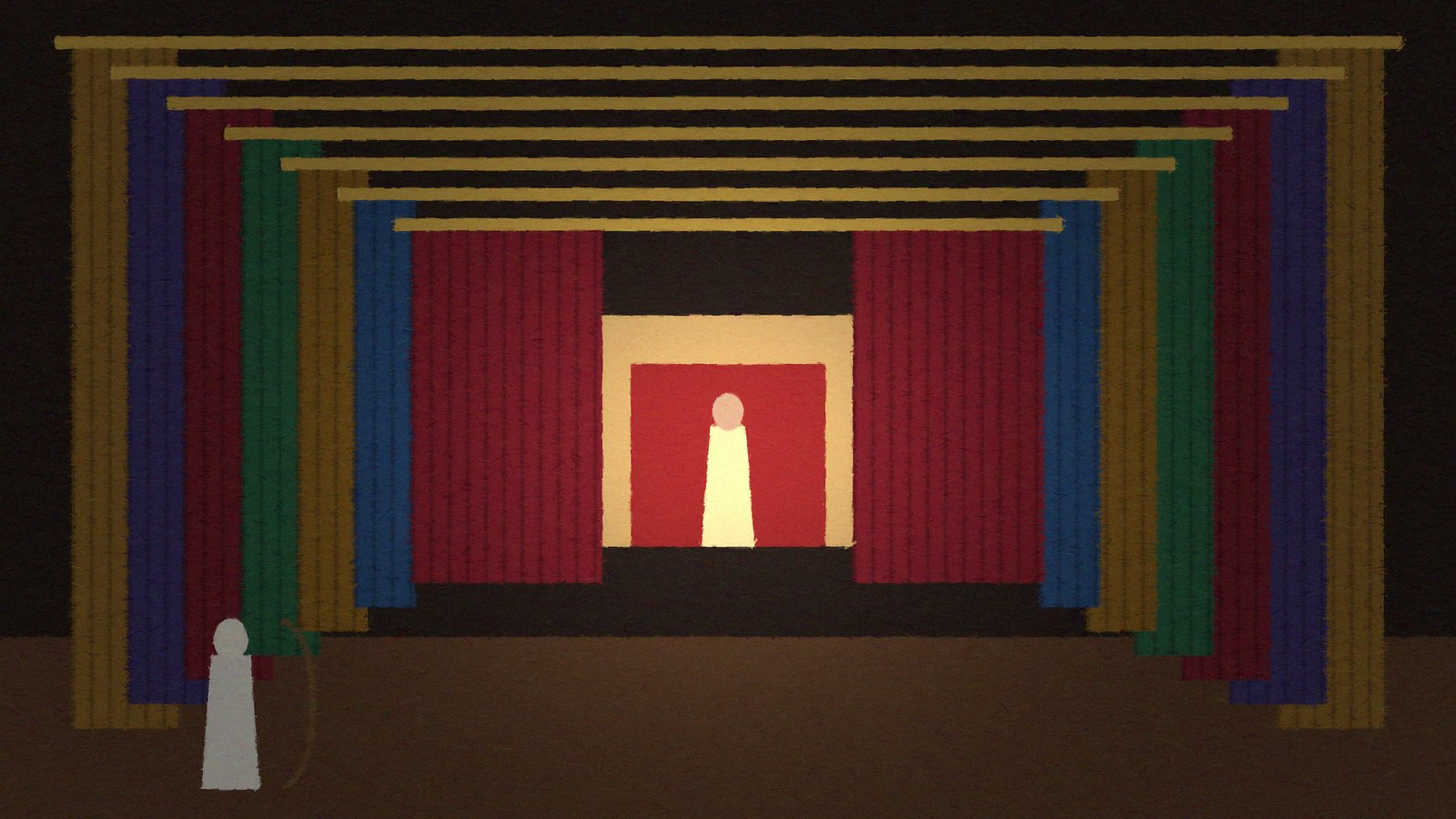
Seven curtains
After the long War of al-Basus between Bakr and Taghlib, King ʿAmr ibn Hind mediated between the two tribes and took hostages from each as a guarantee of the peace. Then an incident occurred: a party of Taghlib travelling in the desert lost seventy men to thirst, and Taghlib accused Bakr of having denied them water. The two sides took the case to the king.
Taghlib’s chief, ʿAmr ibn Kulthum, author of the Muʿallaqa we have just read, spoke for Taghlib. For Bakr spoke an aged man of Banu Yashkur, al-Harith ibn Hilliza.
Al-Harith suffered from leprosy, and the king disliked seeing him. So the reports say he recited his poem from behind seven curtains. Hind, the king’s mother, was listening, and was so taken by what she heard that she said: never have I heard a man say such words from behind seven curtains. The king ordered a curtain raised, and it was raised; then another, until all seven were raised, and the king brought him close and fed him from his own food.
The king then ruled for Bakr, and ordered the hostages’ forelocks shorn and the hostages returned to their people.
Source: Doha Historical Dictionary of Arabic, entry on al-Harith ibn Hilliza; Abu al-Faraj al-Isfahani, “Kitab al-Aghani”; al-Tabrizi’s commentary on the Ten Odes.
We close the issue with the ode that completes and answers the story of ʿAmr ibn Kulthum. The two poets stood before the same king in the same case. But one came with boasting and threats, and the other with argument and eloquence. The comparison holds a lesson in two kinds of pushing back.
First axis: “many a dweller whose dwelling grows wearisome”
آذَنَتْنا ببَينِها أسماءُرُبَّ ثاوٍ يُمَلُّ منه الثَّواءُبعدَ عهدٍ لنا ببُرقةِ شمّاءَفأدنى ديارِها الخَلصاءُ
Asmaʾ has told us of her parting; many a dweller is one whose dwelling grows wearisome,
after our time together at the stony ground of Shammaʾ, and the nearest of her abodes is al-Khalsaʾ.
The ode opens by announcing parting: Asmaʾ has told us she is leaving. Then the second half-line brings a striking piece of wisdom: many a dweller’s stay becomes wearisome. Staying long can become a burden. Here is a calm acceptance of change that we do not find in ʿAmr ibn Kulthum’s ode. Al-Harith is an old man who knows the days change, and does not resist that with boasting.
Second axis: a camel like an ostrich
Al-Harith describes the camel on which he relies against his cares, and likens her to an ostrich with young. In Arabic poetry the ostrich symbolises both speed and wariness: it runs far from danger and returns to its young. It is a fitting image for a poet who came to protect his people from a looming danger, not to attack anyone.
Third axis: the journey of the plea
The real journey in the ode is the journey of the argument. Al-Harith builds his defence as a lawyer builds his plea. He begins by describing the opponent’s position:
إنّ إخوانَنا الأراقمَ يَغلونَ علينا في قِيلِهمْ إحفاءُ
Our brothers the Araqim go too far against us in their words, and exaggerate.
The Araqim are Taghlib. The reader notices that he calls them “our brothers”. He does not begin with enmity but recalls the kinship that binds Bakr and Taghlib, both of Rabiʿa. Then he describes their error: they go too far in their words and exaggerate the accusation. Then he pins down the core injustice of their charge:
يخلطونَ البريءَ منّا بذي الذَّنــبِ ولا ينفعُ الخَليَّ الخَلاءُ
They mix the innocent among us with the guilty, and the blameless gains nothing from his innocence.
This line is a rule of justice: the innocent may not be taken for the sin of the guilty, nor a whole tribe made to bear the crime of some of its members. It is a principle the Quran would establish as a general rule: “No bearer of burdens shall bear the burden of another” (Al-Anʿam 6:164). Al-Harith states it before Islam, in a plea before a king.
Argument and boasting
Comparing the two poets reveals two kinds of contention before a ruling authority. ʿAmr ibn Kulthum pushed back with force: boasting of the tribe and threatening folly beyond the folly of the foolish. Al-Harith pushed back with argument: refuting the accusation, distinguishing the innocent from the guilty, and recalling kinship.
According to the report, al-Harith won the case. Not because argument always wins; we do not claim that. But because the arbiter was a king who held power, and boasting of power was not something that would persuade him. When you stand before someone stronger than you, argument is your only effective instrument. We saw this lesson in the third issue with Ida B. Wells, who built her case on her opponents’ numbers, and with Ibn al-Nafis, who criticised Galen from within his commentary.
The irony is that ʿAmr ibn Kulthum himself would later kill this king, according to the report. The force that did not win the case in court turned to the sword outside it. That is an ancient picture of what happens when one side loses faith in arbitration.
The limits of the reading
The story of the seven curtains is beautiful, but the narrators differ over it, and some reports say al-Harith had prepared his poem in advance rather than improvising it. The order of events between al-Harith’s plea and ʿAmr ibn Kulthum’s killing of ʿAmr ibn Hind is not settled in the sources. And al-Harith praised the king lavishly in his ode, which leads some scholars to see in it a skilful political plea more than a testimony to justice.
Closing the issue
Seven Muʿallaqat, and seven patterns of pushing back. Two winds contending and so preserving the trace, in Imruʾ al-Qays. A young man pushing back the injustice of his kin and then satirising a king, in Tarafa. A sage praising those who pushed back war with wealth, in Zuhayr. A weak cow pushing back the dogs when there is no escape, in Labid. Boasting that oversteps pushing back into aggression, in ʿAmr ibn Kulthum. A slave pushing slavery off himself with his sword and holding back from the spoils, in ʿAntara. And an old man pushing back an accusation with argument, in al-Harith.
These poets did not know the Quran; they lived before its revelation. But they described precisely a world in which forces push against each other. The Quran came after them to say that this contention is a law, and to give it a check they did not know: that it be a pushing back of corruption, not folly upon folly.
Issue contents: The Seven Muʿallaqat on the Scale of Pushing Back