Tarafa ibn al-ʿAbd: The Young Man Who Carried His Own Death Warrant
He satirised a king at twenty, and the king sent him with a sealed letter to his governor ordering his death. His companion opened his own letter and was saved; Tarafa refused to open his.
Editorial board
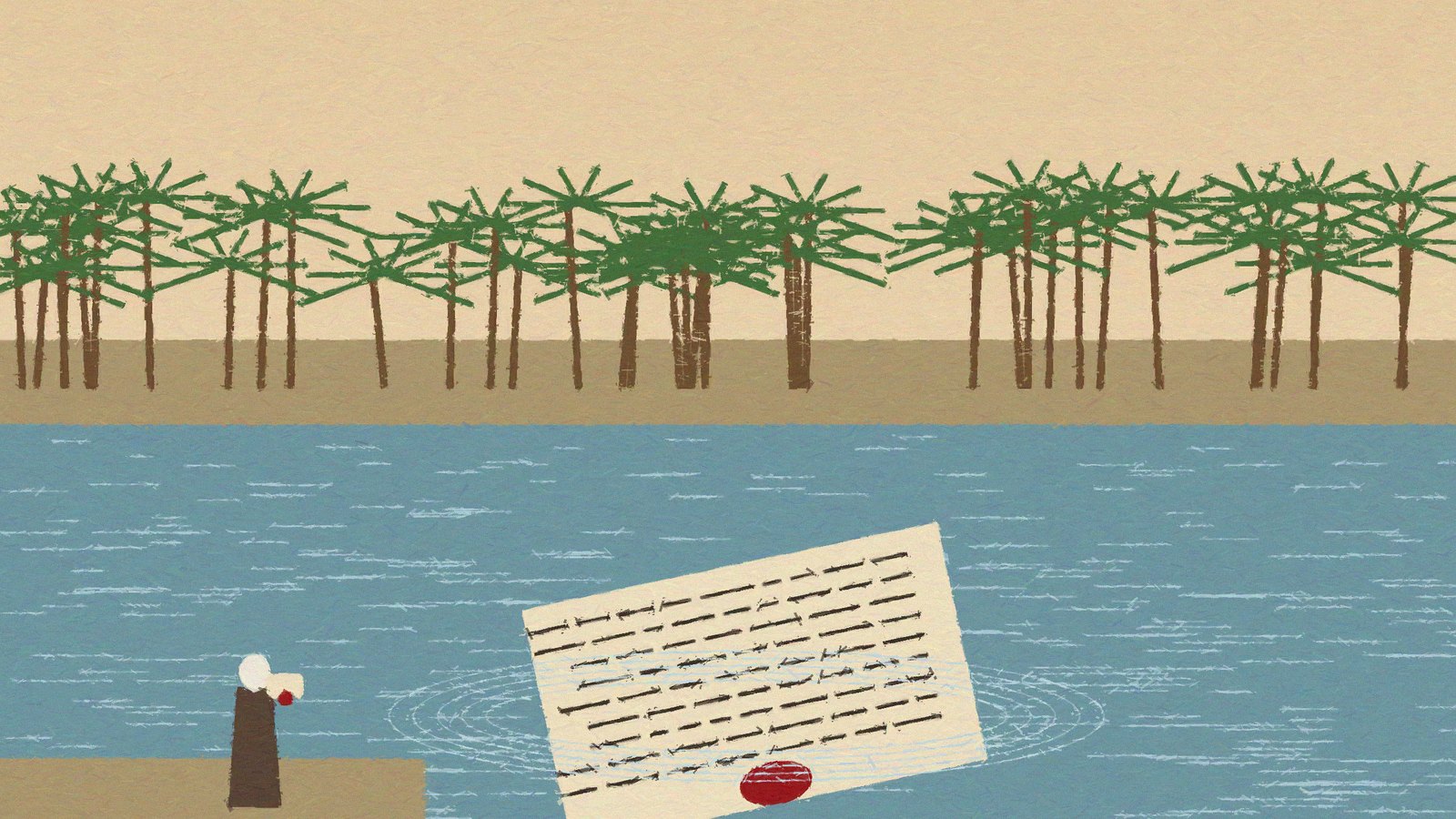
The letter of al-Mutalammis
Tarafa ibn al-ʿAbd was a young man of the Bakr ibn Waʾil tribe, an orphan whose uncles cheated him of his inheritance; he lived extravagantly in amusement and drink until his people shunned him. He stayed with his maternal uncle al-Mutalammis, also a poet, at the court of ʿAmr ibn Hind, king of al-Hira.
The reports say Tarafa satirised the king in biting verses, and they reached him. The king did not show his anger. Instead he summoned Tarafa and al-Mutalammis and gave each a sealed letter to his governor in Bahrain, leading them to believe it ordered that they be honoured.
On the way al-Mutalammis grew suspicious. He passed a boy of al-Hira who could read, and gave him his letter; the boy read it, and it contained an order to kill him. Al-Mutalammis threw his letter into the river of al-Hira and told Tarafa: open your letter; it says what mine says. Tarafa refused, saying the king would not dare harm him.
Tarafa went on to Bahrain. When the governor read the letter, he had him killed. He was about twenty-six. “The letter of al-Mutalammis” became a proverb for one who carries in his own hand what will destroy him.
Source: Abu al-Faraj al-Isfahani, “Kitab al-Aghani”; Ibn Qutayba, “al-Shiʿr wa al-Shuʿaraʾ”. The versions of the story differ in their details.
Tarafa’s Muʿallaqa is the poem of a young man who knows life is short. It holds wisdom astonishing in a poet in his twenties, and a recklessness that explains his end. In our reading it is the poem of contention between the individual and the group: an individual wronged by his kin, who then faced a king with words.
First axis: ruins like the remains of a tattoo
لِخَولةَ أطلالٌ بِبُرقةِ ثَهمَدِتلوحُ كباقي الوشمِ في ظاهرِ اليدِ
Khawla has ruins in the stony ground of Thahmad, glimmering like the remains of a tattoo on the back of the hand.
Tarafa sees Khawla’s ruins like the remains of a tattoo on the back of a hand. The image is precise: a tattoo is a trace that never quite disappears but fades over the years. That is what time does to abodes: it does not remove them at once but weakens them until they are a trace barely seen. Pushing back against time, for Tarafa, is not a battle to be won but a resistance to fading, in which poetry preserves what time erases.
Second axis: the camel that carries off cares
وإنّي لأُمضي الهمَّ عندَ احتضارِهِبِعَوجاءَ مِرقالٍ تروحُ وتغتدي
When care comes upon me, I dispatch it on a lean, swift-trotting she-camel that travels evening and morning.
Tarafa describes his camel in the longest passage of his ode, so precisely that it has been counted among the finest descriptions of camels ever made. The line that opens the description reveals its function: he “dispatches care” with it, pushing back his cares through movement and travel. His mount is not merely a means of transport but an instrument for pushing away what weighs on the soul. When a place grows too narrow for a person, departure itself is pushing back.
Third axis: a journey through life, not desert
Tarafa’s journey in his ode is less a journey through space than through life. He knows the days diminish him every night:
أرى العيشَ كنزًا ناقصًا كلَّ ليلةٍوما تنقُصِ الأيامُ والدهرُ ينفدِ
I see life as a treasure diminishing every night, and what the days and time diminish runs out.
From this awareness springs his philosophy: since life is short, let it be lived with courage. When the people call for someone to take on a task, he assumes they mean him and does not hang back:
إذا القومُ قالوا مَن فتىً خِلتُ أنّنيعُنيتُ فلم أكسَلْ ولم أتبلّدِ
When the people say, “Who is the man?”, I think it is I who am meant, and I am neither idle nor dull.
The ode contains a line that has become one of the most famous Arabic proverbs, and it is the key to his life:
وظُلمُ ذوي القربى أشدُّ مضاضةًعلى المرءِ مِن وقعِ الحُسامِ المُهنَّدِ
The injustice of kin is more painful to a man than the blow of a sharp Indian sword.
Tarafa did not begin his contention with the king, but with his family, who cheated him of his inheritance and shunned him. This recalls what we established in the second issue: contention within a single group is sometimes harsher than contention with outsiders, because the one who pushes cannot treat his opponent as an enemy.
The word and the ruler
Tarafa’s story poses a question everyone who has pushed back against power with words knows: when is daring courage, and when is it recklessness? In the third issue we read the life of al-ʿIzz ibn ʿAbd al-Salam, who faced sultans with legal rulings and survived because he had an independent source of strength: his learning, his standing with the people, and his ability to lead them out with him. Tarafa faced the king while living at his court, with no tribe to protect him, his people having shunned him. His word was a push with no strength behind it.
His refusal to open the letter combines courage and pride. He did not believe the king would dare harm him. And his own ode contains a line that could have saved him had he acted on it:
ستُبدي لكَ الأيامُ ما كنتَ جاهلًاويأتيكَ بالأخبارِ مَن لم تُزوِّدِ
The days will show you what you did not know, and news will come to you from one you did not provision.
News did come to him from one he had not provisioned: the boy who read al-Mutalammis’s letter. But Tarafa did not listen.
The limits of the reading
The reports of Tarafa’s killing differ in detail, and some scholars think the story of the letter was shaped after his death to explain it, and that the real reasons were political, tied to his tribe’s relations with the kings of al-Hira. The attribution of some of the wisdom lines in his ode is also debated, since they seem more mature than his years. But what is established is that a young poet was killed on the order of a king he had satirised, and that his ode went on being recited after him.
Issue contents: The Seven Muʿallaqat on the Scale of Pushing Back